
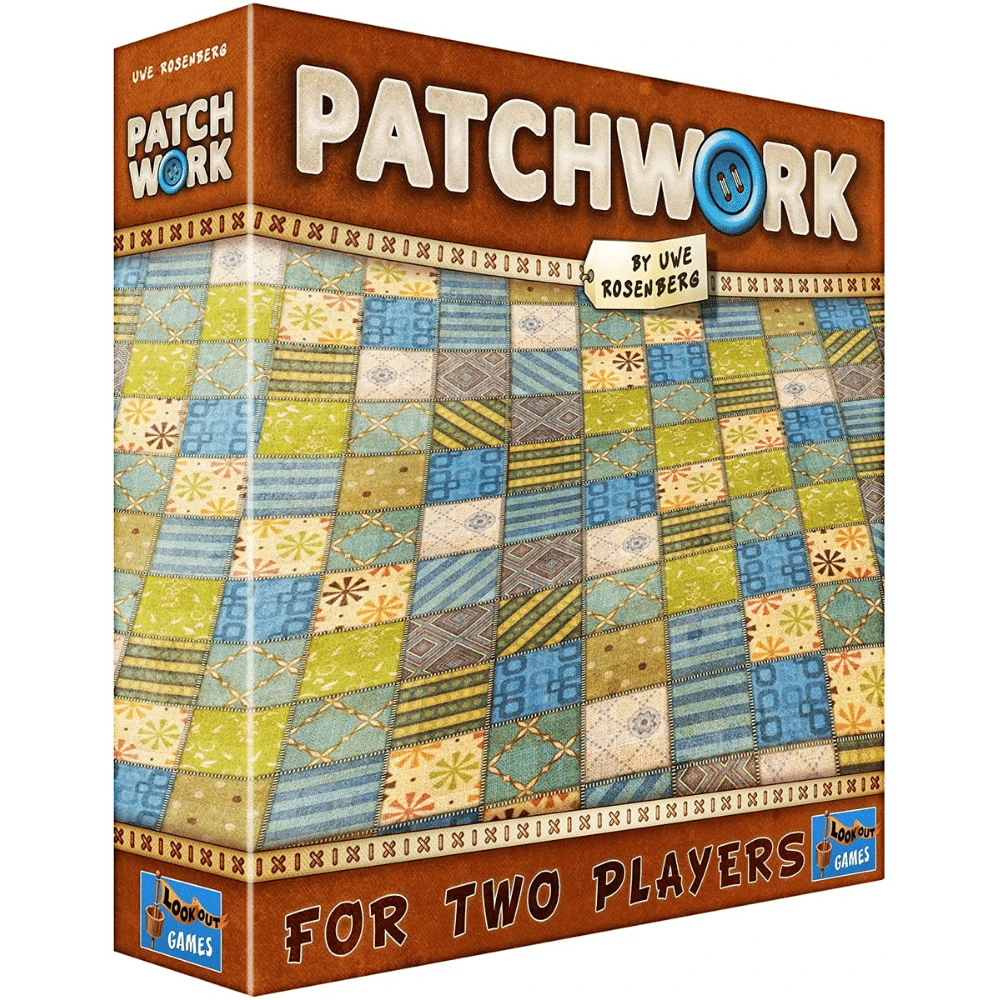
Patchwork(Patchwork)
Original price was: £20.75.£14.53Current price is: £14.53.
- Free Shipping over $25
- Fast & reliable delivery options
- Enjoy top quality items for less
- Multiple safe payment methods

In Patchwork, two players compete to build the most aesthetic (and high-scoring) patchwork quilt on a personal 9×9 game board. To start play, lay out all of the patches at random in a circle and place a marker directly clockwise of the 2-1 patch. Each player takes five summarys — the currency/points in the game — and someone is chosen as the start player.
On a turn, a player either purchases one of the three patches standing clockwise of the spool or passes. To purchase a patch, you pay the cost in summarys shown on the patch, move the spool to that patch’s location in the circle, add the patch to your game board, then advance your time token on the time track a number of spaces equal to the time shown on the patch. You’re free to place the patch anywhere on your board that doesn’t overlap other patches, but you probably want to fit things together as tightly as possible. If your time token is behind or on top of the other player’s time token, then you take another turn; otherwise the opponent now goes. Instead of purchasing a patch, you can choose to pass; to do this, you move your time token to the space immediately in front of the opponent’s time token, then take one summary from the bank for each space you moved.
In addition to a summary cost and time cost, each patch also features 0-3 summarys, and when you move your time token past a summary on the time track, you earn “summary income”: sum the number of summarys depicted on your personal game board, then take this many summarys from the bank.
What’s more, the time track depicts five 1×1 patches on it, and during set-up you place five actual 1×1 patches on these spaces. Whoever first passes a patch on the time track claims this patch and immediately places it on his game board.
Additionally, the first player to completely fill in a 7×7 square on his game board earns a bonus tile worth 7 extra points at the end of the game. (Of course, this doesn’t happen in every game.)
When a player takes an action that moves his time token to the central square of the time track, he takes one final summary income from the bank. Once both players are in the center, the game ends and scoring takes place. Each player scores one point per summary in his possession, then loses two points for each empty square on his game board. Scores can be negative. The player with the most points wins.
Players: 2
Ages: 8+
Playing Time: 30 Minutes
Be the first to review “Patchwork(Patchwork)”
Related products

Asmodee Recommended

Asmodee Recommended




Card Games
Asmodee Recommended
Dragon Ball
Reviews
There are no reviews yet.